
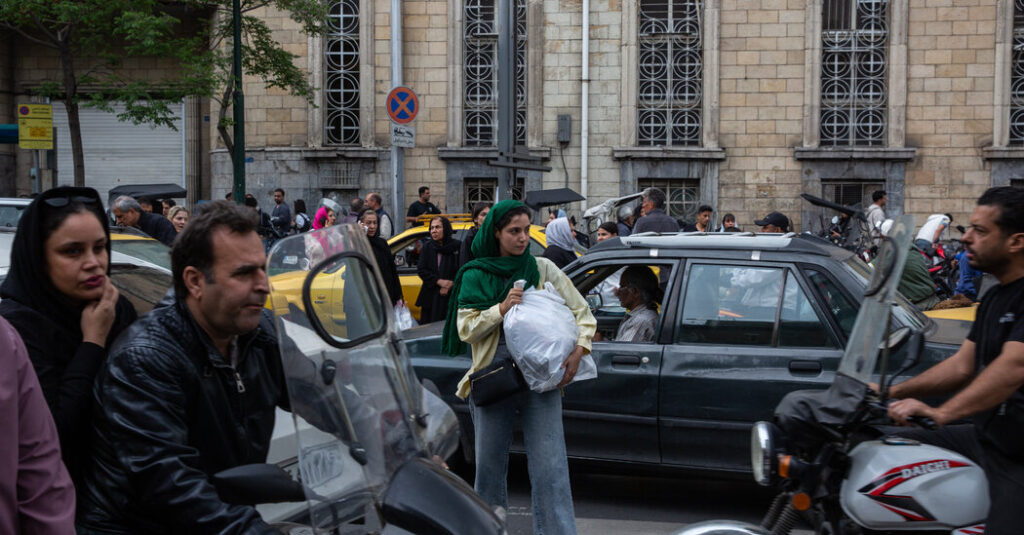
In the days before proposed talks aimed at ending the war between their countries, President Trump and Iranian leaders exchanged a barrage of threats and insults that played out like a high-stakes game of chicken.
In the end — at least, from Iran’s perspective — Mr. Trump blinked first.
By late Tuesday, Iranian and American mediators had not traveled to Pakistan for a second round of peace talks, and Mr. Trump announced an indefinite cease-fire with Iran. He said it was to give Iran’s leadership time to submit a response to American demands and would last until “discussions are concluded, one way or the other.”
For Iranian leaders, that result will most likely validate their conviction that their readiness to endure the pain of the war is higher than Mr. Trump’s.
Despite the vast destruction from U.S.-Israeli strikes on their country, they believe that they can withstand the increasingly costly U.S. blockade of Iranian ports longer than Mr. Trump is willing to countenance Iran’s effective closure of the vital Strait of Hormuz.
“The Iranians measure the timeline in months for themselves, and in weeks for the Trump administration and the global economy,” said Ali Vaez, the Iran project director for the International Crisis Group. “They think Trump can’t tolerate the strait remaining closed for another three weeks.”
Since the war began, Iran has been blocking most of the shipping traffic that previously moved about one-fifth of the world’s oil and a substantial amount of natural gas supplies through the strait. The impact has been felt around the world, not just in rising oil prices, but in shortages in fertilizer, cooking gas and helium critical to semiconductors. Rising gas prices in the United States also create a domestic problem for Mr. Trump in a crucial midterm election year.
After a first round of talks between Iranian and American negotiators in Islamabad, Pakistan, ended without a breakthrough, Mr. Trump imposed a retaliatory U.S. naval blockade to try to prevent vessels heading to or from Iran, blocking Tehran’s ability to continue the oil exports that underpin its economy.
The reasons for the collapse of the talks remain unclear. Mr. Trump has blamed a “seriously fractured” Iranian leadership, unable to agree on its position before negotiations. Iranian officials argue that it is because Mr. Trump had refused to lift the U.S. blockade before talks, with American forces also seizing an Iranian-flagged ship over the weekend.
“Blockading Iranian ports is an act of war and thus a violation of the ceasefire,” Iran’s foreign minister, Abbas Araghchi, wrote on social media late on Tuesday, as it became apparent that no one was heading to Islamabad. “Striking a commercial vessel and taking its crew hostage is an even greater violation,” he continued. “Iran knows how to neutralize restrictions, how to defend its interests and how to resist bullying.”
With the cease-fire extended, Iran’s appetite for tit-for-tat escalation with Washington may be rising. The Islamic Revolutionary Guards Corps said it had seized two cargo ships near the Strait of Hormuz on Wednesday, according to state media.
“An eye for an eye, a tanker for a tanker,” Ebrahim Rezaei, a spokesman for the Iranian Parliament’s national security and foreign policy committee, wrote on social media, not long after that announcement.
Throughout the war, Iran has used mocking memes and videos to try to convey superiority and indifference in the face of Mr. Trump’s threats. After Mr. Trump said the cease-fire would be extended, many Iranian semiofficial news sites posted a mock video of an angry Mr. Trump, threatening to bomb Iran, and of his American mediators sitting in an empty negotiating room. The Iranian counterparts, who never arrive, instead deliver a piece of paper that reads: “Trump, shut up.”
Abdolrasool Divsallar, an Iran expert at the Catholic University of Milan, said the major impediment to negotiations restarting was the same as it was before talks began — both countries see themselves as having the advantage and being able to dictate terms.
“The Iran side views their ability to prevent the U.S. operation from achieving its objectives as a victory,” he said. “They assume the Trump administration may not have any other good alternatives and that time will favor them if they hold on in this status quo.”
But the Trump administration sees its position similarly, and may believe that it can strike a middle path by avoiding a renewed military assault while continuing the naval blockade.
Both sides can point to signs of the pain they are causing. The German airline Lufthansa said that it would cut 20,000 flights, just the latest example of how fuel shortages are affecting global commerce.
Scott Bessent, the U.S. Treasury secretary, wrote after the cease-fire extension announcement that the U.S. blockade would soon take a major toll on Iran’s oil fields. With exports largely blocked, Iran’s may run out of storage space for its oil, he pointed out. That could impede its ability to pump more fuel from its wells, a result that can cause lasting damage to oil fields.
Whether or not Iran’s leadership can survive the standoff with Washington, its economy may not, analysts warn. The economy was already in deep crisis before the war.
Even if Iran’s leaders can push through the economic pain, it will come at a huge cost to its people. On social media, Iranians post daily about immense job layoffs, and about fears over medicine and petrochemical shortages after U.S.-Israeli strikes hit critical infrastructure.
Mahdi Ghodsi, an economist at the Center for Middle East and Global Order, a research organization, said the damage Iran had incurred in the war — an estimated $270 billion, according to its central bank — could lead to a 15 percent drop in productive capacity in Iran.
About two million Iranians are estimated to have already lost jobs during the war — around 7 percent to 8 percent of the official employment, he said.
Iranian politicians who defiantly shrug off the destruction as something they can rebuild later, Mr. Ghodsi said, are ignoring the fact that in the absence of a new deal with Washington, Iran will remain a country under heavy sanctions — and one unlikely to find many donors willing to support reconstruction.
“They don’t have money, and they don’t have credit for that,” he said. “They can’t print more money to finance their infrastructure or oil fields.”
He anticipates a further depreciation to Iran’s currency, already in free-fall since last year — a crisis that set off the huge nationwide protest movement in December and January that the regime later crushed in a deadly crackdown.
Rapidly deteriorating economic conditions were on the minds of nearly every Iranian interviewed by The New York Times on Wednesday as they passed through the Kapikoy crossing on the Turkish-Iranian border.
Moji, 38, who was returning to her family in the city of Urmia, in northwestern Iran, from Europe, said she had been devastated by the destruction of her hometown’s factories. She said she had friends there who could barely afford to eat, with so little work to be found. Like many Iranians, she asked to be identified by only her first name for her safety.
“Everyone wants something better to happen,” she said. “But unfortunately the path that unfolds for our people is not the right path, and in the end that which should happen, doesn’t happen. People just suffer more mentally and have to pull back financially.”
Yet most experts still expect that none of these hardships will change the Iranian government’s current course.
“The Iranian regime only cares about its survival, not about its people suffering, and it does still see this as an existential battle with the United States,” said Mr. Vaez of the International Crisis Group. “And that’s why it’s not going to blink, regardless of how much the Iranian people suffer.”
Yeganeh Torbati and Sanam Mahoozi contributed reporting