
When Nugzar Rukhadze, an accomplished Georgian journalist, worked in Atlanta in the 1980s, he was constantly troubled by the need to explain at length that he actually came from a different Georgia.
“It was a pain in the neck,” he said in his book-laden apartment in central Tbilisi, the capital. “I would say that I am from the country of Georgia which is between Turkey and Russia on the Black Sea coast opposite Romania,” said Mr. Rukhadze, now 84. “I always had to be very wordy.”
Ever since it emerged as an independent nation from the ashes of the Soviet Union in 1991, Georgia, with fewer than four million people, has struggled with being confused with the more populous and prosperous American state more than 6,000 miles away.
The arrival of artificial intelligence and its use in internet searches has intensified the confusion. Having a distinctive name is crucial for visibility, but search engines and the large language models that power chatbots often prioritize whatever is more frequently mentioned, creating problems for the country of Georgia and its businesses.
Sharing a name with an entity that has a much bigger digital footprint makes it a lot harder to get noticed online, said Marc Fetscherin, a professor of marketing at Rollins College in Florida who specializes in international branding.
“Algorithm replaced atlas,” he said. “Today with A.I. and with S.E.O., the confusion can be emphasized” to the nation of Georgia’s disadvantage.
At times, misidentification produces amusing results. President Trump’s 2024 campaign placed an ad on Facebook targeting Georgia voters, with a stock image of the Caucasus Mountains.
Luna Kaishauri, a Georgian graphic designer, was contacted and retained by an entrepreneur from Augusta, Ga. “I’m pretty sure that he finally realized that I’m from the other Georgia only after a while,” said Ms. Kaishauri, 51. “We ended up working together very productively for many years.”
But the confusion can also take a menacing turn. During simultaneous electoral campaigns in both countries in 2024, activists posted on social networks about potential vote fraud in post-Soviet Georgia. That drew furious reactions from American readers who at first thought the posts were about the other Georgia, where Mr. Trump had claimed vote fraud in 2020.
For years, Mr. Rukhadze, who now works at a TV station in Tbilisi, and others thought they saw a simple fix: Use the right name.
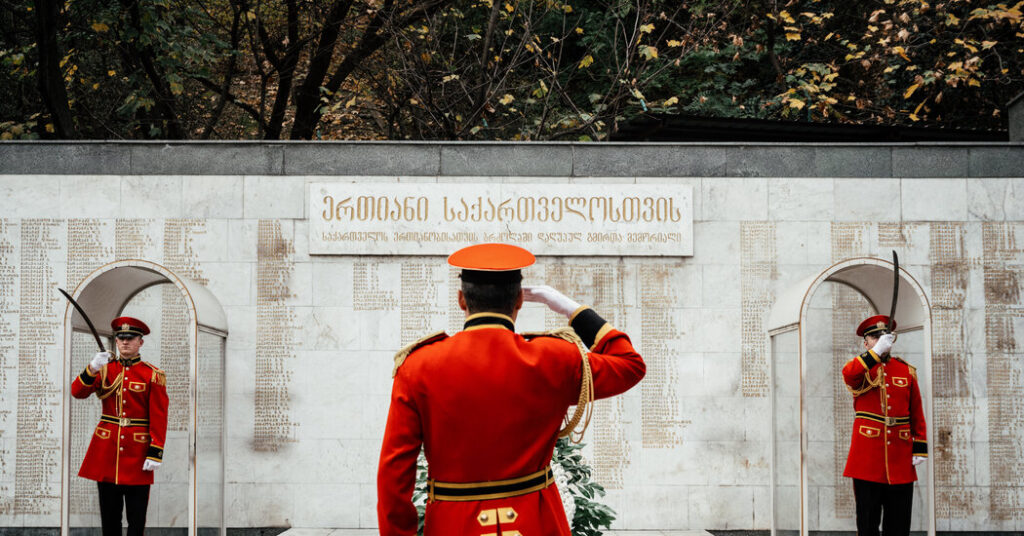
Georgians call their country Sakartvelo, the name used in official documents, soccer chants and everyday conversation in Georgian. But the government, when using English and other tongues, bows to the reality that much of the world says “Georgia.”
The etymology of Georgia as a name for the country is a subject of debate. It most likely stems from an ancient Persian root that Western Europeans later adapted because of its similarity to St. George.
By contrast, the origin of the name of the state is simple. It is named after King George II of Britain, who granted a charter to establish a colony in North America.
Some countries have changed names for reasons of pride, politics and identity. Burma became Myanmar, Ceylon became Sri Lanka, and Swaziland became Eswatini, casting off colonial legacies. The Turkish government asks that its country be called Türkiye abroad, as it is at home, which has the advantage of not sounding, in English, like either a bird or an insult.
The appeal of the name Sakartvelo is tied to Georgians’ pride in their ancient, distinctive language and its script, a writing system used nowhere else. Georgian and few other Caucasian tongues are interrelated but, as far as linguists can tell, not related to any other languages.
Mr. Rukhadze wrote editorials about the need to use the name Sakartvelo, and joined forces with Anzor Babukhadia, an economist, who kicked the cause into high gear more than a decade ago. Mr. Babukhadia, at one time an adviser to the country’s president, pushed civil society organizations to endorse the change, and won support from a faction in Parliament.
Lithuania, another former Soviet state, switched to calling Georgia “Sakartvelas,” adjusting the name to Lithuanian phonetics.
But the campaign got no further. Georgia’s foreign ministry objected to changing the name in foreign contexts, citing expenses and confusion, and Mr. Babukhadia died in 2017, leaving his mission without its leader.
“Everyone wanted to do this, but he was the only one who had the energy,” said his wife, Tinatin Kankava, 77. “Sakartvelo as a name unites us all.”
Now, there is little sense of urgency about using Sakartvelo, as much as the idea appeals to people. Politically engaged Georgians are more preoccupied with debating the country’s geopolitical orientation. Over the past year, Tbilisi’s main thoroughfare, Rustaveli Avenue, has been the stage for noisy protests over what the opposition says is the country’s slide into pro-Russian authoritarianism.
The country is stuck with its foreign name, said Mariam Chkhartishvili, 70, a professor and former director of the Institute of Georgian History, and its people “can somehow explain the difference between Georgia the country and Georgia, a state of America.”
Mr. Fetscherin, the marketing specialist, said keeping the name Georgia and contextualizing it could be a branding opportunity.
“You can call Georgia ‘the real Georgia’ ” he said, “or ‘the original Georgia.’”