
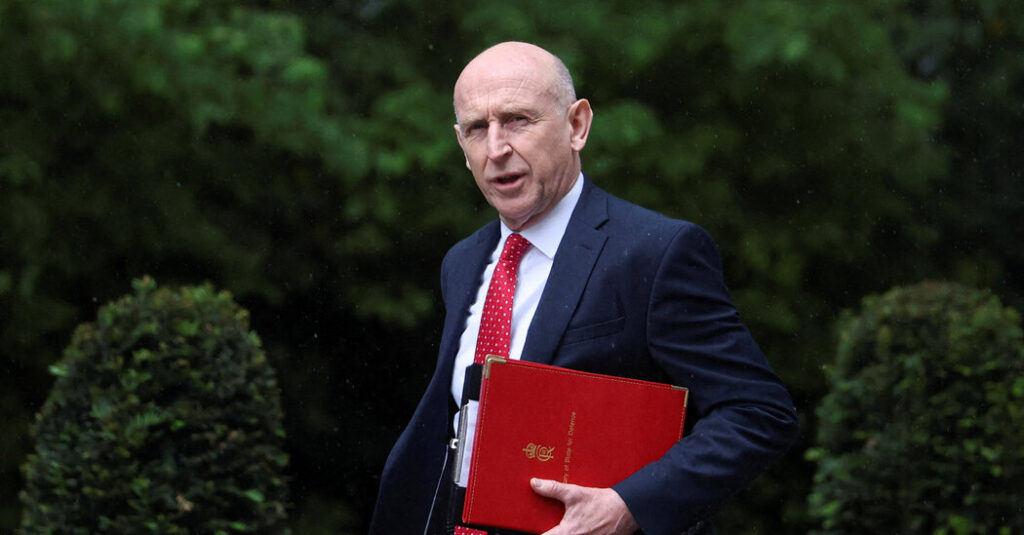
John Healey, Britain’s defense secretary, resigned on Thursday, accusing Prime Minister Keir Starmer of failing to invest enough money in defense and leaving the country “well short” of what it needed to protect itself in a dangerous world.
Mr. Healey, who has been one of Mr. Starmer’s staunch allies, said he was informed on Monday that Mr. Starmer intended to announce a Defense Investment Plan that would not increase funding for the military as much as Mr. Healey believes is necessary.
“I am being forced to make decisions that would reduce the readiness of our forces and increase the risk to personnel on operations, and could make the country less safe,” Mr. Healey wrote in a letter to the prime minister that he posted on social media.
The unexpected resignation is a blow to Mr. Starmer, who is likely to face a challenge to his leadership of the Labour Party later this summer. Mr. Healey’s declaration of no-confidence in the prime minister adds another argument for critics who say the party needs a change at the top.
Mr. Healey said that Mr. Starmer’s plans would increase military spending to 2.68 percent of gross domestic product by 2030, short of the 3.0 percent that Mr. Healey and Mr. Starmer had discussed in the past.
“After explaining to you that I would not be able to accept a DIP settlement that does not give our forces the resources they need,” Mr. Healey wrote, “I am now left with no other option than to submit my resignation as your defense secretary.”
Questions about how much Britain plans to invest in the military have swirled through the halls of government for months as Mr. Starmer repeatedly delayed releasing the long-term defense plan.
A year ago, Mr. Starmer’s government published a strategic defense review, which called for a significant improvement to military readiness, including the addition of British-built long-range weapons, the creation of a cyber command, and the development of drones and new ways to protect undersea cables.
During a visit to a shipyard in Glasgow in June 2025, Mr. Starmer said, “The threat we now face is more serious, more immediate and more unpredictable than at any time since the Cold War.” He pointed to “war in Europe, new nuclear risks, daily cyberattacks,” and “growing Russian aggression,” in British waters and skies.
There has also been immense pressure from President Trump, who has repeatedly accused Britain and other nations in Europe of failing to spend enough on their own defense. Mr. Trump has mocked the British Navy as being “too old,” with aircraft carriers “that didn’t work.”
But the sluggish economy in Britain has made it challenging for Mr. Starmer to find the money for a big lift in military spending without making politically unpopular decisions such as tax increases, cuts in other domestic programs or large-scale borrowing.
Each of those options comes with steep downsides. Tax increases would be highly contentious in a country where levies on the population are already relatively high. Many people in Britain remember with anger the steep cuts to popular services, known as austerity, that were put in place by the previous Conservative Party-led government. And financial markets would likely respond poorly to more government borrowing.
Rachel Reeves, the chancellor of the Exchequer, said this week that tax increases would be better than borrowing to pay for defense.
Government officials had refused to say as recently as Wednesday afternoon what Mr. Starmer had decided to do. A spokesman told reporters on Wednesday that the investment plan would be unveiled before a NATO meeting at the beginning of July.
In Parliament on Wednesday, Kemi Badenoch, leader of the Conservative Party, accused Mr. Starmer of delaying because of concerns about how to pay for the defense investments.
“Projects have been put on hold, and Britain is getting weaker with every passing day,” she said. “At a time of increased global instability and tension, with war in Europe and the Middle East, the prime minister is paralyzed, giving the armed forces less than half of the minimum that they need.”
Mr. Starmer responded by noting that military spending had fallen during the 14 years that Ms. Badenoch’s party was in power. He noted that his government had already agreed to increase it to 2.6 percent, from 2.3 percent, by 2027.
“We have carried out a strategic review of defense, and we are committed to publishing the defense investment plan before the NATO summit,” he said.