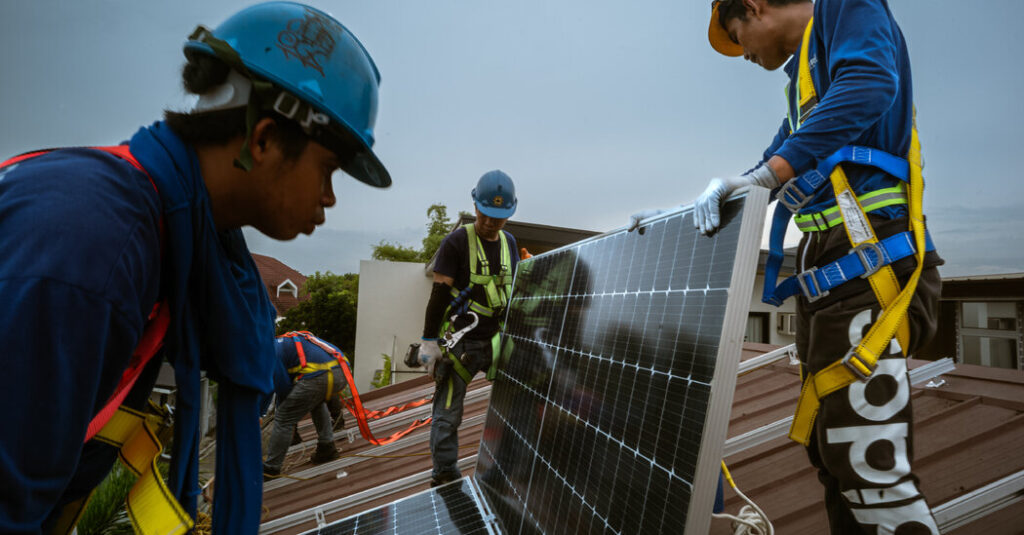
In March, a few weeks after the war in Iran began jolting energy markets, Heidi Mendoza had solar panels installed on the roof of her three-story house in Marikina, Philippines, from where she teaches financial literacy classes online. “I got scared that we might lose electricity,” she said.
Last month, Ming Kuang Chai, an architect in Kuala Lumpur, Malaysia, made a similar addition to his home. “The Iran war, and the fact that I drive an electric car, pushed me to install the panels quickly to manage my living costs,” he said.
Adiana Julia hopes to add her parents’ house in Yogyakarta, Indonesia, to the solar-powered ranks early next year. “It’s better if we can find ways to reduce our dependence on the grid,” she said.
This shift is occurring in many parts of Southeast Asia, a region whose energy sector is heavily reliant on oil imported via the Strait of Hormuz, which has been effectively closed since the war began. The United States and Iran have announced a preliminary agreement to end the war and the strait may reopen soon. But the economic fallout from the conflict will last much longer, and in some cases may change consumer behavior for good.
Days after U.S.-Israeli strikes on Iran started the war on Feb. 28, the Philippines declared a national emergency, warning of rolling blackouts as the price of oil skyrocketed when traffic in the strait came to a standstill. That was the cue for Ms. Mendoza, 63, who had long considered adding solar power to her house. She spent 390,000 Philippine pesos, about $6,500, to prevent disruptions in power supply.
Otherwise, she said, “I wouldn’t be able to do my online work.”
The increase in demand has been beneficial to China, the world’s largest maker of solar panels. In March, it sold 5.5. gigawatts of solar capacity to Southeast Asia, more than twice as much as the previous year, according to Wood Mackenzie, a consulting firm. That capacity is enough to power 1.45 million homes for a year, said Wan Afiq Naqiuddin, an analyst at the firm.
Some customers were stockpiling panels because a tax holiday was expiring in China. But exports in April also stayed above typical levels, according to the most recent data available.
That has translated into a boom for companies like GoSolar Philippines, which sells panels across the country. Orders have recently increased fivefold, according to Aibar Rabi Rashad Bibi, the firm’s chief executive.
“Households are increasingly turning to rooftop solar to offset rising electricity bills,” said Angelo Kairos dela Cruz, the executive director of the Institute for Climate and Sustainable Cities, a think tank in Quezon City, the Philippines. “While businesses, particularly those with high daytime energy consumption, are adopting solar to manage operating costs.”
Some governments in the region, including Malaysia’s, had already been giving incentives for solar-panel installations to reduce dependence on fossil fuels.
Still, the pace has picked up recently.
“After the war, consumers want larger rooftop solar systems. And we are installing more now, between 8 to 10 houses a day from 5 to 7 houses previously,” said Jaran Walia, deputy chief executive of SOLS Energy, a solar provider based in Kuala Lumpur.
The cost of panels has also decreased. Prices, which fell to a record low of 9 cents per watt in December, are a fraction of what they were a decade ago because of the rapid expansion of manufacturing in China
In Cambodia, where many farms use solar energy, the authorities removed all import duties on solar panels and energy storage systems starting April 1. Even before that, solar panel imports set a record in March, according to the Institute for Energy Economics and Financial Analysis, reaching a capacity of 422 megawatts.
Indonesia still largely relies on coal for energy, but the government has set a goal to generate 100 gigawatts from solar within three years. Still, consumers complain that installing solar panels on their homes is not straightforward. A 2024 law allows individuals to set up solar systems that are connected to the local grid only twice a year, in January and July. Ms. Julia is planning to wait until January.
But Aris Yanto, 52, ordered solar panels online and installed them himself without connecting to the grid. “The voltage here often fluctuates and power outages happen almost every day so I don’t want to depend on the grid,” he said.
In Thailand, where solar panel imports are also near record levels, the authorities are hoping to finalize rules to allow households to sell surplus electricity from rooftop panels to the national grid.
Moves like these, according to Mr. Naqiuddin, the analyst, are likely to continue across Southeast Asia.
“These countries would still look for solar as a near-term solution for energy security, as unpredictable geopolitical events like what happened in Hormuz might happen again in the future,” he said.
Hasya Nindita contributed reporting from Yogyakarta, Indonesia, and Sun Narin from Phnom Phenh, Cambodia.