
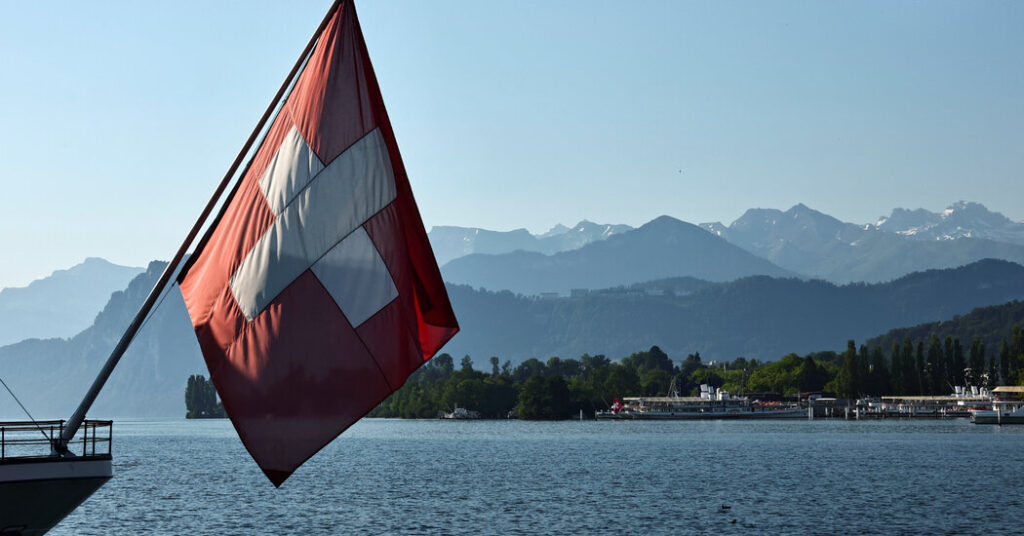
Through much of Thursday, Switzerland was preparing for what promised to be a moment of clarity in a muddied week of efforts to end the war in Iran. Swiss officials were readying a luxury lakeside resort for crucial new negotiations to flesh out the preliminary deal. Air Force Two sat on a runway outside Washington, ready to carry Vice President JD Vance there.
At 3 a.m. on Friday, Swiss time, a message arrived from America: Mr. Vance wasn’t coming. The talks had been shelved, with little explanation and no rescheduling. “The logistics of these negotiations have never been simple or predictable,” a White House statement said. Diplomats later said that Iran had pulled out of the talks to protest Israeli strikes in Lebanon, where Israel is fighting with the Hezbollah militia, an Iranian ally.
The reversal capped a week of confusion that had already engulfed President Trump’s efforts to seal — and sell — an agreement with Iran that was only a few days old. Among the points of confusion:
-
The exact parameters of the agreement took days to become public, and they remain shrouded in questions. Iranian and American officials are describing them in wildly different terms — with American leaders insisting the deal included promises that do not appear in its text.
-
The agreement does not resolve crucial questions about Iran’s nuclear program, or whether the Strait of Hormuz, the crucial maritime trade route off southern Iran, would continue to be open for free passage. It delays those to a second, 60-day negotiating period that has just begun. But talks have been postponed, with no clarity on when they will begin, or what will happen if the questions remain unresolved.
-
Leaders of the United States and Israel, the countries that started the war together, disagree sharply about the deal. It is unclear if Israel will abide by it, and new confrontations between Israel and Hezbollah, Iran’s ally in Lebanon, already seem to have jeopardized it.
These complications have upended what was meant to be a stabilizing moment for global politics, trade and markets, leaving world leaders wondering aloud about what might happen next.
“I think it’s regrettable,” Micheál Martin, the prime minister of Ireland, told reporters on Friday outside a meeting of European leaders in Belgium. “It’s in some respects not surprising. But I would urge continued dialogue, adherence to the agreement, because the world needs stability and the world needs peace.”
It wasn’t initially clear when the deal was signed.
The crescendo of confusion began to build on Sunday, when the president announced the deal but did not say immediately what was in it. There were initial discussions of holding a signing ceremony that day, on the shores of Lake Geneva near Switzerland’s western border with France.
On Monday, after the weekend passed without a public signing, Mr. Vance announced that actually the deal had already been signed electronically.
Then on Tuesday, Swiss officials announced the deal would be signed in person after all — on Friday, at the Qatar-owned Bürgenstock Resort Lake Lucerne, about an hour outside of Zurich.
By Wednesday, Mr. Trump had scuttled that plan, putting ink to paper during a dinner at Versailles, outside Paris, after a Group of 7 leaders’ meeting in eastern France. The Trump administration did not clarify whether that document was the same as the one signed digitally on Sunday.
Details emerged slowly, but questions persisted.
The uncertainty was compounded by the fact that it took three days for the Trump administration to share the full text of the deal with the public. In the meantime, the media published unconfirmed reports about it, and American officials, including Mr. Trump and Mr. Vance, made ambiguous claims about whether it would provide Iran with financial relief.
Mr. Vance said on Monday that the agreement could allow Iran to access a $300 billion reconstruction fund, raised by what he called the “Gulf Coast coalition.” Mr. Trump then posted on social media that the U.S. would not pay that money — without saying whether it would be paid by others.
Speaking at the G7 summit on Wednesday,
Mr. Trump gave two different answers about the deal in the same minute. Asked if it contained “immediate sanctions relief” for Iran, the president shook his head and said, “No.” Asked again, he said: “They have to behave well.”
By that same afternoon, Mr. Trump still had not specified what the agreement consisted of, even as he praised its contents. “Nobody knows what it is, but it’s very strong,” he said.
His administration finally revealed details hours later, not through formal publication of the text, but by a senior White House official reading the agreement out, point by point, to reporters.
Yet Mr. Trump remained evasive about whether he would stick to the accord, joking that he might blame Mr. Vance if failed.
“It’s a memorandum of understanding,” Mr. Trump said. “If it doesn’t get done in 60 days, that’s all right, we go back to bombing.”
Israel vowed to fight on.
The uncertainty increased after it became clear that Israel fiercely opposed the deal, as did many congressional Republicans.
Prime Minister Benjamin Netanyahu of Israel said in a televised address that he did not feel bound by the memorandum of understanding. “The struggle has not ended,” Mr. Netanyahu declared, pledging to keep Israeli troops stationed in southern Lebanon to battle Hezbollah, the Iran-backed Lebanese militia.
Senator Ted Cruz, an Iran hawk, said he believed that the “president is receiving some really bad advice” on the deal. “History demonstrates that giving billions of dollars to theocratic lunatics who want to murder us is an exceptionally bad idea,” Mr. Cruz said.
Mr. Vance took the lead for the administration in pushing back against critics, doing a series of interviews and a briefing at the White House on Thursday. He said the agreement was proceeding smoothly behind the scenes, even as he defended its contents with a series of vague and misleading claims.
“I don’t think our public messaging has been chaotic,” Mr. Vance said. “I think dealing with a fractured Iranian system, where communication isn’t great, is just sometimes something that we don’t fully appreciate, or we don’t fully understand.”
And Mr. Vance took aim at Mr. Netanyahu’s ministers, some of whom had fiercely criticized Mr. Trump for reaching an agreement with Tehran. “If I was in the cabinet of the Israeli government, I might not be attacking the only powerful ally that I have anywhere left in the entire world,” Mr. Vance said.
Further negotiations were postponed.
European leaders welcomed the deal when it was announced, but as the week continued they grew increasingly cautious about whether it would hold. Emmanuel Macron, the French president, was asked by a television anchor on Thursday who won the Iran war. “I don’t think we can say it’s totally over,” he replied.
Still, as of late Thursday, officials in Europe and America expected the next round of negotiations to start Friday morning at the Bürgenstock resort. Reporters were moving toward Lake Lucerne for coverage. A press pool had gathered to accompany Mr. Vance.
But Friday morning dawned, warm and bright in Zurich, with no sign of the vice president. Swiss officials confirmed that the negotiations were off for now.
“Switzerland remains ready to facilitate these talks,” the Swiss foreign ministry said in a brief news release. “The relevant preparatory work at Bürgenstock is continuing. No further information can be provided at present.”
Koba Ryckewaert and Jeanna Smialek contributed reporting from Brussels, and Zolan Kanno-Youngs contributed reporting from Washington.