
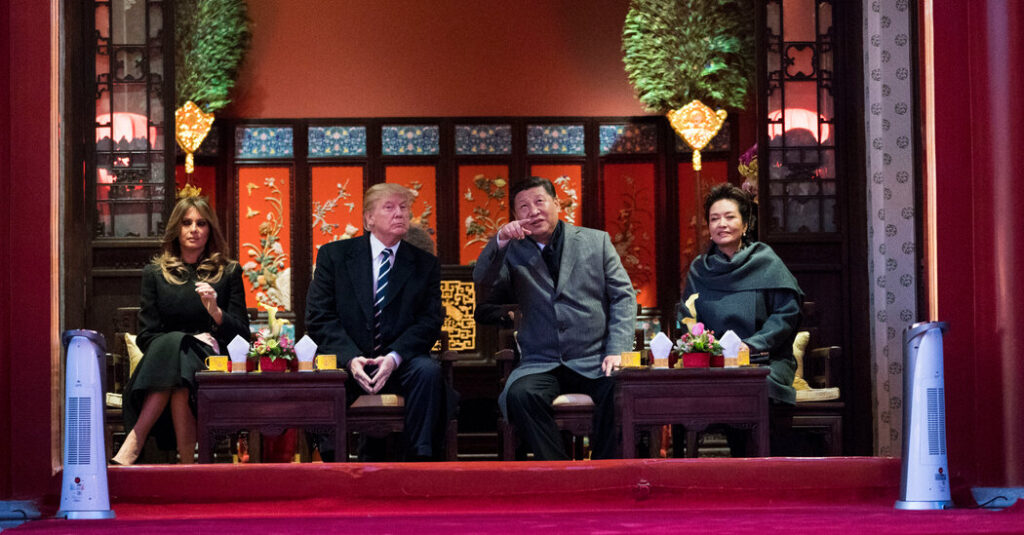
China’s leader, Xi Jinping, delivered a warning on Taiwan to President Trump as the two leaders began their summit in Beijing on Thursday, saying that the issue, if handled poorly, could lead to a clash and “an extremely dangerous situation.”
The two leaders met in the Chinese capital with a heavy dose of pageantry and an exchange of pleasantries and praise. But Mr. Xi’s warning was a stark reminder that the self-governing island, which is claimed by China, is a red line for Beijing.
The meeting, the first U.S. presidential visit to China in nearly a decade, could determine whether a détente that has prevailed between the superpowers will continue — and what concessions, if any, either side is willing to make. Taiwan, trade and the Iran war are among the issues the leaders are expected to discuss at the high-stakes summit.
Mr. Xi greeted Mr. Trump on Thursday morning outside the Great Hall of the People in central Beijing. They shook hands before walking together past an honor guard and rows of cheering children. As “The Star-Spangled Banner” played, a 21-gun salute echoed across Tiananmen Square.
Inside the Great Hall, both leaders hailed the importance of the U.S.-China relationship. Mr. Xi called for the two countries to work together to confront an increasingly “complex and turbulent world.”
“We should be partners, not adversaries,” he said.
Mr. Trump emphasized his personal relationship with Mr. Xi, and said the two leaders speak to each other on the phone to work out problems. “You’re a great leader,” he told Mr. Xi, with both delegations seated facing each other at a long table.
But the Chinese leader made clear on that Taiwan had the potential to spoil the relationship. “If handled poorly, the two countries will collide or even clash, putting the entire U.S.-China relationship in an extremely dangerous situation,” he said while referring to Taiwan, according to a readout from Xinhua, China’s official news agency.
One of China’s related priorities is persuading the United States to curtail its arms sales to Taiwan. In a phone call in February, Mr. Xi urged Mr. Trump to handle the issue of these sales with “extreme caution.”
There was little indication ahead of the summit that there would be any progress on major issues such as trade.
The two men last met in October in South Korea, where they agreed to pause a bruising trade war in which Beijing had threatened to impose sweeping new restrictions on exports of rare earths in response to triple-digit U.S. tariffs on Chinese goods. Mr. Xi decided at the time to postpone those measures for a year. A question looming over the summit is whether China will agree to an extension.
Mr. Trump has said that his trip to Beijing, which will include meetings with Mr. Xi at historic landmarks and conclude on Friday, will focus on trade and investment. Several top executives, including Jensen Huang of the chip giant Nvidia, have joined the president in China. American business leaders have been pushing for measures that would further open the Chinese market, though analysts say that a major deal is unlikely.
Chinese customs data on Thursday showed that the government has approved beef export licenses for several hundred American slaughterhouses. The export licenses for these slaughterhouses had expired last year after Mr. Trump’s initial round of tariffs.
The president is also expected to call on Mr. Xi to help persuade Tehran, China’s closest partner in the Middle East, to end the deadlocked war that the United States and Israel started in late February.
Mr. Xi will have other priorities. Analysts say that apart from Taiwan, he may push for the loosening of U.S. export controls on advanced technology, and for pledges from Mr. Trump not to raise tariffs on Chinese goods, among other things.
Forcing major shifts in U.S. policies toward Taiwan would be a long shot. But then again, Mr. Xi has a powerful card to play: China’s economic leverage over Iran, and the prospect that it could potentially help to reopen the Strait of Hormuz, the crucial waterway that has been blocked since the war started.
Here’s what else we’re covering:
-
Summit Security: Chinese officials rolled out an array of security measures in Beijing, closing parks and major roads. Armed officers were stationed outside Mr. Trump’s hotel. Read more ›
-
Human Rights: Mr. Trump has said he will raise the case of Jimmy Lai, an imprisoned pro-democracy media mogul, during his trip. Other human rights issues, including the systemic repression of the Uyghurs, are unlikely to make the agenda. Read more ›
-
Imperial Style: In private meetings with less powerful foreign leaders, Mr. Xi carries himself as a philosopher king in the mold of ancient Chinese rulers. Read more ›