
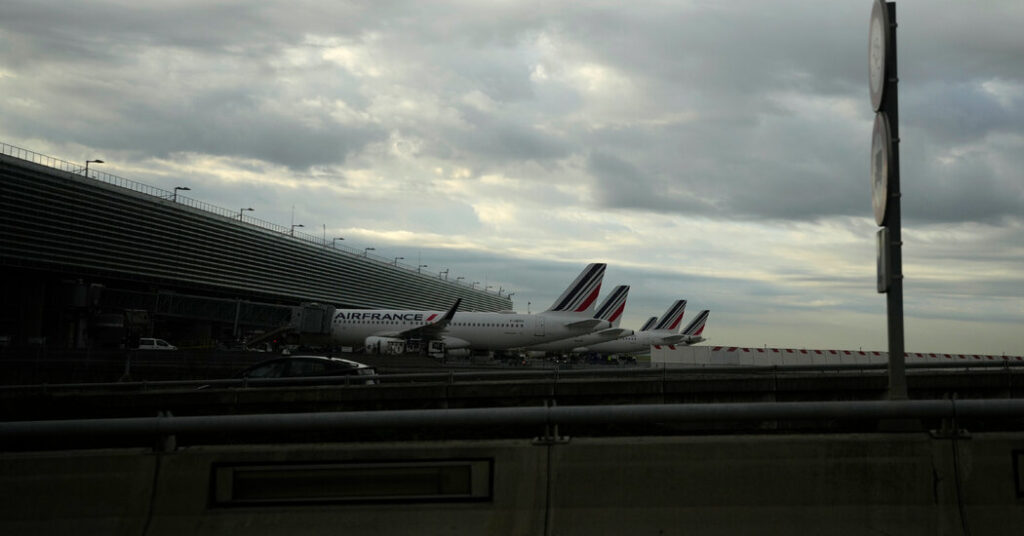
Early in April, Ruben Hallali got an unusual alert on his phone: The evening temperature at Paris Charles de Gaulle International Airport had jumped about 6 degrees Fahrenheit in seconds.
Mr. Hallali, the chief executive of the weather risk company Sereno, had set up notifications for extreme weather swings. Then, nine days later, it happened again.
“It was an isolated jump, at one single station, early in the evening,” said Mr. Hallali, who added that he noticed another strange coincidence about the spikes: The timing was just right for somebody to reap a windfall on the betting site Polymarket.
He wasn’t the only one who sensed a problem. Météo-France, the country’s national meteorological service, filed a complaint last week with the police and local prosecutors, saying it had evidence that a weather sensor at Charles de Gaulle, the country’s largest airport, may have been tampered with.
The temperature swings, experts said, coincided with a period of unusual activity on Polymarket, one of the leading online prediction markets. Wagers on the daily high temperature in Paris totaled nearly $1.4 million over the two days, with some receiving thousands of dollars in payouts, according to the company’s data.
Prediction markets like Polymarket and Kalshi allow users to wager on the outcome of virtually anything. One increasingly popular area is weather betting, where speculators can make real-time wagers on temperature readings, rainfall totals, the number of Atlantic hurricanes in a year and much more.
As the stakes have risen, so has the temptation to tamper with the instruments used to generate weather readings in hopes of engineering a lucrative outcome. Experts warn that this could have dangerous ripple effects, like degrading the information that underpins safe air travel.
Temperature data is used in a host of calculations at airports, helping determine correct takeoff distance, climb rate and whether crews need to apply frost treatment to planes. It’s crucial to airport safety, Mr. Hallali said.
“The Charles de Gaulle incident is not an isolated curiosity,” Mr. Hallali said. “It is what happens when financial incentives meet fragile data infrastructure.”
On April 6, the temperature reading at Charles de Gaulle jumped from 64 degrees Fahrenheit to 70 degrees at 7 p.m., before slowly falling over the next hour, according to data from Météo-France.
On April 15, the recorded temperature climbed even more sharply, from 61 degrees at 9 p.m. to 72 at 9:30 p.m., then dropping back to 61 a half-hour later.
In both instances, the spikes set the high temperature for the day, the metric on which some Polymarket wagers rest.
Laurent Becler, a spokesman for Météo-France, said the service contacted the police after noticing the discrepancies in temperature data. He declined to comment further on the case, saying it was under investigation.
Mr. Hallali said that after the first instance, experts and commenters on the French weather forum Infoclimat began to search answers. Theories were floated, including user error. But after the second spike, commenters zeroed in on the unusual Polymarket wagers.
The sums bet on April 6 and 15 were hundreds of thousands of dollars higher than on typical days this month.
It is not the first time that strange bets on prediction markets have raised accusations of insider trading.
On Thursday, a U.S. Army special forces soldier who helped capture President Nicolás Maduro of Venezuela in January was charged with using classified information to bet on outcomes related to Venezuela, making more than $400,000 on Polymarket. Late last year, another trader on the site made roughly $300,000 betting on last-minute pardons from President Joseph R. Biden Jr. before he left office.
Polymarket did not immediately respond to a request for comment. While the site used to tie some bets to temperature readings at Charles de Gaulle, this week, after Météo-France filed its complaint, the platform began using temperatures taken at another airport near the city, Paris-Le Bourget, according to recent bets on the site.
Representatives for Charles de Gaulle airport declined to comment beyond saying that the case was under investigation. The airport police also declined to comment. The Bobigny Public Prosecutor’s Office, which is handling the case, declined to answer questions about the investigation but said that no complaint had been filed against Polymarket.
As to how the instruments could have been tampered with, a number of theories have been offered online, including by use of a hair dryer or a lighter. Mr. Hallali said that the precision of the spike on April 15 suggested the use of a calibrated portable heating device, although he declined to speculate about what kind.
“Markets are expanding into every domain where an outcome can be observed, measured, and settled,” he said. “As these markets multiply, so does the surface area for manipulation.”