
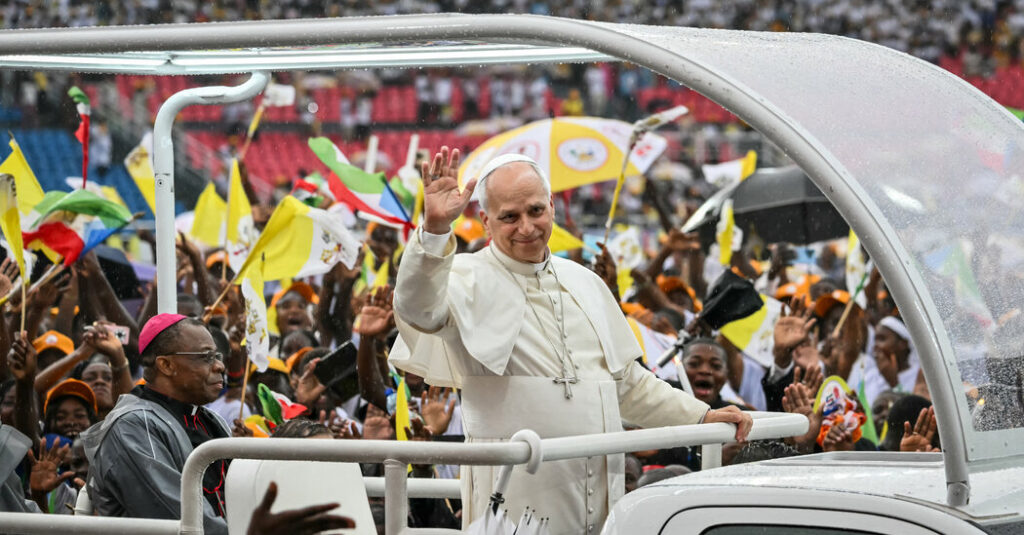
When Pope Leo XIV talks, people listen.
Yet he is learning that he can’t always control how they hear him.
From the very beginning of Leo’s 11-day trip to Africa, which ended on Thursday, his mission to highlight injustice across the continent was interpreted through the lens of his dispute with President Trump.
Leo’s remarks in Algeria, Cameroon, Angola and Equatorial Guinea were almost drowned out by his comments on the first flight of the trip, when he responded to a diatribe about him Mr. Trump posted on social media after the pope spoke out repeatedly against the war in Iran. Leo told the reporters traveling with him that he had “no fear” of the Trump administration.
As the trip wore on, the pope’s subsequent criticisms of authoritarian behavior were viewed as being aimed as much at Mr. Trump as they were at African leaders. Collectively, his increasingly forthright comments also appeared to suggest that a previously cautious pontiff had finally found his voice.
He didn’t always seem to like how people took what he said. Halfway through the trip, Leo addressed the media frenzy surrounding his dispute with Mr. Trump, telling the journalists accompanying him that commentators had misinterpreted some of his words in Africa as further criticism of the American president.
It almost seemed as if he were backing away from his unflinching stance and trying to return to the early days of his papacy, when both liberal and conservative Catholics embraced him as someone who resisted easy ideological categorization.
In his still young papacy, Leo has begun to speak more pointedly about world events, including the U.S.-Israeli attacks on Iran. But as a trained canon lawyer, he wants people to interpret him narrowly, even as he often speaks in vague biblical metaphors and seemingly alludes to the actions of political leaders without naming them.
“My sense with this latest stuff is he wanted plausible deniability,” said Miles Pattenden, a historian at Oxford University who studies the church. “Obviously the pope can’t lie, but he can say things in such a way that there’s more than one way of reading it.”
The pope chastised news outlets for creating what he said was an inaccurate narrative around a speech in Cameroon, where he lamented a world “ravaged by a handful of tyrants.” Many news outlets, including The New York Times, said he seemed to be speaking not only to local leaders but also to Mr. Trump.
The pope said that the comments had been prepared two weeks earlier and that it was “not in my interest at all” to continue to debate the president.
Mr. Pattenden said he was skeptical of the pope’s “nothing to see here” explanation. “Anyone, even one of my students, knows that you can revise your remarks from two weeks ago,” said Mr. Pattenden. “And it’s probably a good idea to do that if you can foresee that people are going to interpret it in a particular way.”
Leo’s predecessor, Pope Francis, was more likely to provoke and could even appear energized by conflict. Francis was “totally comfortable being in uncomfortable situations,” said David M. Lantigua, an associate professor of theology at the University of Notre Dame. “I don’t think that Leo shares that kind of temperament.”
Still, the pope, who met with leaders of authoritarian governments that have cracked down on dissent and fostered massive inequality, seemed willing to take some of them on from the pulpit.
Speaking to reporters on the plane home on Thursday, Leo also continued to criticize the war in Iran, lamenting that the conflict had caused “the death of so many innocents.” He also expressed frustration at the slow pace of peace negotiations. “One day Iran says ‘yes’ and the United States says ‘no,’ and vice versa,” he said, “and we don’t know where it goes, which has created this chaotic situation for the global economy.”
William T. Cavanaugh, a political theologian at DePaul University in Chicago, noted that Leo kept criticizing the war — and authoritarianism writ large — even after he backed away from the direct confrontation with Mr. Trump.
“But he did sound like he just didn’t want to be portrayed as being in a pissing match with Donald Trump,” said Mr. Cavanaugh.
In Algeria, Leo told those “who hold positions of authority” that they should “promote a vibrant, dynamic and free civil society.”
In Cameroon, where Leo met with Paul Biya, 93, who has ruled the nation for more than four decades, the pope warned against “an idolatrous thirst for profit.”
And in Equatorial Guinea, Leo met the strongman leader, Teodoro Obiang Nguema Mbasogo, who is the world’s longest-serving president and rules over a country with vast reserves of oil but where more than half the population lives under the poverty line. At a Mass on Wednesday where the president accompanied the pope, Leo called for a society that serves the “common good rather than private interests, bridging the gap between the privileged and the disadvantaged.”
Leo, speaking on the plane on Thursday, said he hoped that such engagement with leaders might nudge them toward better governance.
Such engagement, Leo said, is “interpreted by some as the pope or the church is saying, ‘It’s OK that they live like that.’”
But, he said, “It is important to talk to heads of state, to encourage maybe a change of mentality, a greater openness to thinking about the good of the people.”
The question is what effect the pope’s words will have once he has left.
“He has not been afraid to call out bad leaders,” said the Rev. Stan Chu Ilo, a Nigerian priest and professor of Catholic studies at DePaul. But societies and governments, he said, don’t change “just because the pope came.”
“It might even get worse,” Father Ilo said. “The papal visit might also be used as a veneer or mask” for governments seeking validation.
Yet if Leo refused to visit countries ruled by troubling leaders, other scholars said, he risked making it seem as if he didn’t care about Catholics in those places.
“Of course it does run the risk of seeming like you’re legitimizing something that is not good,” said Elissa Cutter, associate professor of religious studies and theology at Georgian Court University in Lakewood, N.J. But, she said, “you want to keep the lines of communication open.”
Zacarias Hossi, 24, a college student in Kilamba, Angola, said he did not expect the pope to shift the thinking of political leaders. “I believe some politicians will listen and are listening,” said Mr. Hossi, laughing. “But others, well, I think you know.”
Leo, now 70, kept up a grueling schedule on the trip, taking 18 flights and saying eight Masses over 11 days, often in remote regions. In addition to his stops at presidential palaces and cathedrals, he visited nursing homes, a psychiatric hospital, universities and a prison, often in intense heat.
In Leo’s words, some people heard the seeds of a different kind of future.
“The way that the pope speaks, he gives us authority,” said Mufua Theophile, 30, who came to see Leo’s final Mass in Yaoundé, Cameroon’s capital, last week.
The pope, said Mr. Theophile, “makes us have hope” that “a new generation of young people can also have freedom to enjoy the rights of the country.”
Gilberto Neto contributed reporting from Kilamba, Angola, and Josephine de La Bruyère from Rome.